Exploring the Gut-Brain Axis: Understanding Your Second Brain
Discover the powerful connection between your gut and brain, revealing how emotional states and digestion are intertwined. Learn why your digestive health is essential for mental well-being.
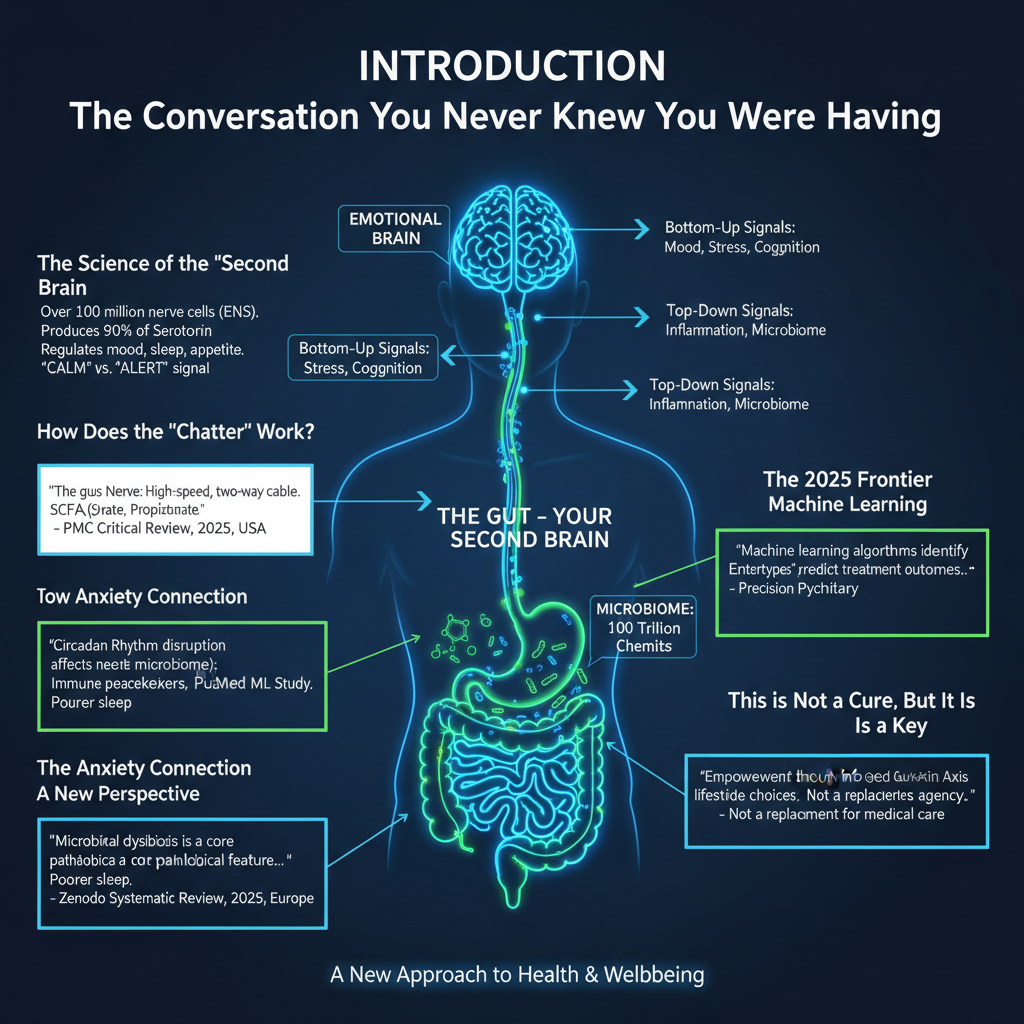
Introduction, The Conversation You Never Knew You Were Having Think back to the last time your stomach dropped. Perhaps it was before a job interview, during an argument, or the moment you received unexpected news. That sudden churn, that hollow tightness, that sensation of your insides twisting into a knot, it arrived before your conscious mind had fully processed the situation. Your brain did not tell your stomach to feel that way; your stomach already knew. For decades, we were taught that our brain is the CEO of our body, a solitary commander issuing orders to silent, passive organs. But modern science has overturned this outdated hierarchy. The gut is not a passive listener; it is an active conversationalist. Welcome to the Gut-Brain Axis, the high-speed, two-way motorway connecting your emotional brain to your digestive tract. Understanding this connection is the foundation of a new approach to health. You cannot truly heal your mind without understanding your middle. The science we share with you comes from leading research institutions across the United Kingdom, the United States, and Europe. This is not fringe science; it is the consensus of the global medical community. "The gut-brain axis has emerged as a transformative framework for understanding anxiety and depression." This comes from the PMC Critical Review, 2025, which is based in the USA.
The Science of the "Second Brain" Hidden within the walls of your digestive system lies the Enteric Nervous System, which is often shortened to ENS. This is a complex mesh of over 100 million nerve cells. This is not a simple relay station; it is a sophisticated neural network that operates largely on its own. Neuroscientists often refer to it as our "Second Brain." Why? Because it produces around 90 percent of the body's serotonin. Serotonin is the very neurotransmitter that regulates mood, sleep, and appetite. When your gut is inflamed or imbalanced, that production falters. The signal to your brain shifts from "calm" to "alert." This is not metaphor; it is biochemistry. "The gut-brain-circadian axis plays a critical role in psychiatric conditions." This comes from the PMC Critical Review, 2025, which is based in the USA. This means the health of your digestive tract directly influences your daily rhythm and emotional resilience. Your gut does not just digest food; it helps regulate when you feel awake, when you feel sleepy, and how strongly you react to stress. Researchers at University College London and King's College London have been at the forefront of this research. Their work confirms that the gut microbiome influences brain development and behaviour from infancy through to old age. "The gut microbiome communicates with the central nervous system through neural, endocrine, and immune pathways." This comes from Cryan and colleagues, 2019, published in Physiological Reviews. This research was conducted at University College Cork in Europe.
How Does the "Chatter" Work? Imagine the Vagus Nerve as a fibre-optic cable running from your brainstem down to your colon. It transmits signals faster than you can blink, and it works in both directions. First, there is the bottom-up signal from gut to brain. When you eat a highly processed meal, the gut releases inflammatory markers that travel up the vagus nerve. This can cloud your thinking, slow your reaction times, and lower your mood within hours. Second, there is the top-down signal from brain to gut. When the brain perceives stress, it sends a "panic" signal downward. This alters how your stomach moves, increases acid production, and changes the permeability of your intestinal lining. This is often referred to as "leaky gut." This is where the microbiome enters the story. Your gut is home to trillions of bacteria that act as miniature chemists. They ferment the food you eat and produce Short-Chain Fatty Acids, which are often shortened to SCFAs. Examples include butyrate, acetate, and propionate. "Microbial metabolites such as short-chain fatty acids regulate neuroinflammation and maintain neuronal health." This comes from the PubMed Machine Learning Study, 2025, which is based in the USA. These metabolites are not waste products; they are the immune system's peacekeepers. They cross the blood-brain barrier to protect your neurons from damage. They also reduce the inflammation that is increasingly linked to depression and brain fog. A 2021 study from the University of Oxford found that dietary fibre intake is directly linked to the production of these beneficial metabolites. This highlights the importance of a plant-rich diet for mental wellbeing. "Higher dietary fibre intake is associated with a lower risk of depression." This comes from the University of Oxford Study, 2021, which is based in the UK.
The Anxiety Connection, A New Perspective The traditional view of anxiety was purely neurochemical. It was seen as a "chemical imbalance" in the brain. The transformative framework of 2025 suggests something far more holistic. "The gut-brain-circadian axis is a critical determinant of mood regulation and stress responses." This comes from the Zenodo Systematic Review, 2025, which is based in Europe and is open access. This means that the bacteria in your gut fluctuate with your sleep-wake cycle. When your circadian rhythm is disrupted, by late-night eating, shift work, or excessive blue-light exposure, your microbiome composition shifts. A compromised microbiome reduces the production of calming neurotransmitters. The result is a lower threshold for stress, poorer sleep quality, and a heightened startle response. "Microbial dysbiosis is a core pathological feature observed in patients with generalized anxiety and major depressive disorders." This comes from the Zenodo Systematic Review, 2025, which is based in Europe and is open access. The gut is not just responding to anxiety; in many cases, it is actively contributing to it. This is why targeting the gut offers a new frontier for mental health support. It is not a replacement for therapy or medication, but it can be a powerful companion. The Mental Health Foundation in the UK has highlighted that diet and lifestyle factors are increasingly recognised as important components of mental health care. Their 2024 report emphasised the need for integrated approaches that consider both physical and mental wellbeing. "Mental health and physical health are inseparable. A holistic approach that includes dietary and lifestyle interventions is essential." This comes from the Mental Health Foundation, 2024, which is based in the UK.
The 2025 Frontier, Machine Learning and Biomarker Discovery The most exciting development in 2025 is the integration of artificial intelligence to decode the Gut-Brain Axis. "Machine learning algorithms are now capable of identifying microbial signatures that predict neuroinflammatory flare-ups with remarkable accuracy." This comes from the PubMed Machine Learning Study, 2025, which is based in the USA. Researchers are using metagenomic sequencing to identify specific "enterotypes." These are distinct bacterial profiles that correlate with treatment outcomes for antidepressants. This is the dawn of "precision psychiatry," where your unique microbiome could one day guide your mental health care. "The integration of AI with microbiome research represents a paradigm shift in biomarker discovery for psychiatric disorders." This comes from the PubMed Machine Learning Study, 2025, which is based in the USA. For the first time, we have the technological tools to understand why one person responds to a dietary change while another does not. The future is personalised, and it starts in your gut. In the UK, the National Institute for Health and Care Research, which is often shortened to NIHR, is currently funding multiple studies exploring the gut-brain connection. These studies aim to develop practical, evidence-based guidelines for clinicians and the public. "The gut-brain axis represents a promising target for novel therapeutic interventions in mental health." This comes from the NIHR Research Briefing, 2023, which is based in the UK.
This is Not a Cure, But It Is a Key It is important to be clear: understanding the Gut-Brain Axis is not a replacement for medical care. It is a tool for empowerment. "Understanding the Gut-Brain Axis provides agency, not a prescription. It empowers individuals to make informed lifestyle choices that support their overall well-being." This comes from the Zenodo Systematic Review, 2025, which is based in Europe and is open access. Important Notice: The information provided in this article is for educational and informational purposes only. It is not intended as medical advice, diagnosis, or treatment. Always consult your General Practitioner, which is often shortened to GP, or a qualified health professional regarding any changes to your diet, lifestyle, or mental health treatment plan. However, by understanding the Gut-Brain Axis, you gain a profound level of agency. You realise that the food on your plate is not just fuel; it is information for your genes and data for your microbiome. The connection between your brain and your belly is one of the most important relationships in your body. It is time to listen to it.
Want to explore this further?
A free 20-minute chat is available if you'd like to talk through how this relates to your own experience, no pressure, no obligation.
Get the free gut-brain health guide
5 things your doctor hasn't told you about your gut and your brain. Evidence-based, no fluff.
No spam. Unsubscribe anytime. Educational content only.
Related Articles

Have a question? We'd love to hear from you.
Send us a message — we respond within 1–2 working days.