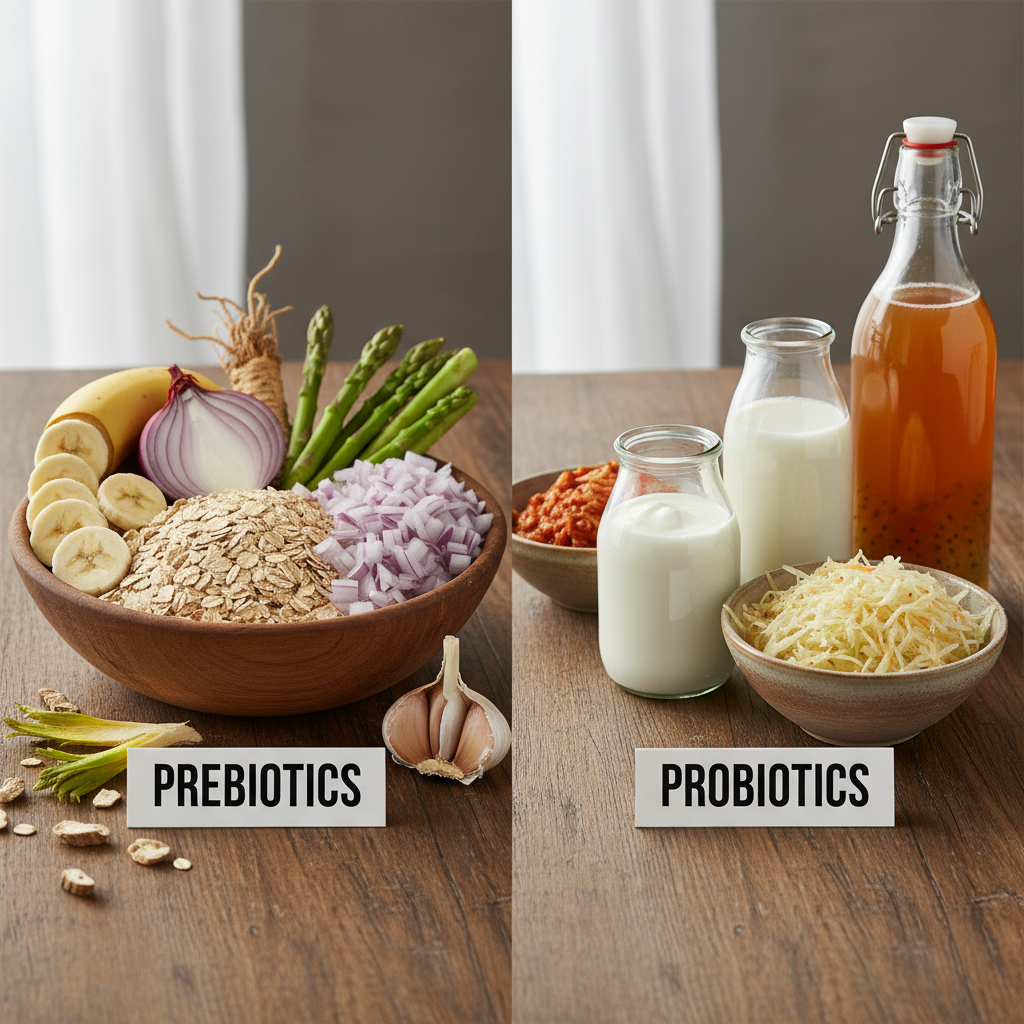
Prebiotics vs probiotics – what's the difference?
A plain English guide to feeding your gut microbiome the right way.
You've heard the words. They're on yogurt pots, supplement bottles, and wellness podcasts. But if someone asked you to explain the difference between a prebiotic and a probiotic — could you?
You're not alone if the answer is "not really." The terms sound similar. They're often mentioned together. And the marketing around both has become so loud that the actual science can feel hard to find.
Let's clear it up. Here's what prebiotics and probiotics actually are, how they work, why both matter for gut health, and — importantly — when to be cautious.
What Are Probiotics?
Probiotics are live microorganisms — mainly bacteria and some yeasts — that, when taken in adequate amounts, can offer health benefits.
Think of them as the "friendly" residents of your gut. They're part of a vast community called the gut microbiome, which lives mainly in your large intestine and influences everything from digestion to immune function to mood regulation.
Common probiotic species you'll see on labels include:
- Lactobacillus — found in yogurt and fermented foods; may help with diarrhoea and lactose digestion
- Bifidobacterium — present in some dairy products; thought to support immune function
- Saccharomyces boulardii — a yeast probiotic studied for antibiotic-associated diarrhoea
Probiotics are found naturally in fermented foods like live yogurt, kefir, kimchi, sauerkraut, miso, and kombucha. They're also available as supplements in capsule, powder, or liquid form.
The key thing to understand: Probiotics are living creatures. They need the right conditions to survive stomach acid, colonise the gut, and do their job. Not every strain works for every person, and effects are strain-specific — a Lactobacillus that helps with IBS bloating won't necessarily help with something else.
What Are Prebiotics?
If probiotics are the friendly residents, prebiotics are their food.
Prebiotics are types of dietary fibre that human enzymes cannot digest. They pass through the small intestine largely intact and arrive in the colon, where gut bacteria ferment them. This fermentation process produces short-chain fatty acids (SCFAs) like butyrate, propionate, and acetate — compounds that nourish the cells lining your gut, regulate inflammation, and support metabolic health.
Common prebiotic fibres include:
- Inulin — found in chicory root, Jerusalem artichokes, onions, garlic, and leeks
- Fructo-oligosaccharides (FOS) — found in bananas, asparagus, and some grains
- Galacto-oligosaccharides (GOS) — found in legumes, including lentils and chickpeas
- Resistant starch — found in cooked-and-cooled potatoes, green bananas, and oats
Prebiotics aren't alive. They're stable in heat and shelf-stable, which makes them easier to formulate into foods and supplements than probiotics.
The key thing to understand: Prebiotics selectively feed beneficial bacteria already present in your gut. They don't introduce new species — they support what's already there.
Why Both Matter
Prebiotics and probiotics aren't rivals. They work together — which is why you'll sometimes see products labelled "synbiotic", meaning they combine both in one formulation.
The analogy worth remembering: Probiotics are the seeds. Prebiotics are the water and fertiliser. You can swallow billions of live bacteria, but if their food source isn't there, they may not stick around long.
Research suggests that combining prebiotics with probiotics may improve the survival and colonisation of probiotic strains in the gut (Gibson et al., 2017). In other words, feeding your existing and introduced bacteria might be just as important as introducing them in the first place.
Can You Just Get Them From Food?
For most people, yes — and food-first is usually the preferred approach.
A diet rich in diverse plant foods (vegetables, fruits, legumes, whole grains, nuts, seeds) naturally provides prebiotic fibres. Adding fermented foods supplies probiotics. The NHS recommends aiming for at least 30 different plant foods per week to support gut microbiome diversity.
Supplements can be useful in specific situations — for example, during or after a course of antibiotics, or when managing specific gut symptoms under professional guidance — but they're not a replacement for dietary pattern.
When to Be Cautious
Prebiotics and probiotics are generally safe for most people, but there are situations where caution matters:
- IBS and FODMAP sensitivity: Many prebiotic fibres are also high-FODMAP, meaning they can trigger bloating, gas, and discomfort in people with irritable bowel syndrome. If you're following a low-FODMAP diet, check whether prebiotic supplements or foods are appropriate for you.
- Severely compromised immune systems: Live probiotics may not be suitable for people who are severely immunocompromised. Always consult a medical professional in these cases.
- Small intestinal bacterial overgrowth (SIBO): Probiotics can sometimes worsen symptoms in active SIBO. Individual assessment is needed.
Want to explore this further?
A free 20-minute chat is available if you'd like to talk through how this relates to your own experience, no pressure, no obligation.
Share this article
Have a question? We'd love to hear from you.
Send us a message — we respond within 1–2 working days.